
Or how I pushed the limits of what seemed possible and discovered they are further away than I thought.
Sports climbing has been a part of my life for more than a decade. It is a hobby that feels a bit more than just that, and an activity that allows me to focus on nothing but a piece of rock and my movement, and to challenge myself. For a better part of those 10 years, I was okay at it. The frequency of my climbing varied a bit with different life phases, and a lot of them left me wishing I could climb more than I did.
My shape also varied between those phases, always staying around 6a and maxing at 6b on the French scale. I always knew I wished to climb a 7a route once in my lifetime, but that was always so far out of reach that it stayed in some undefined future.
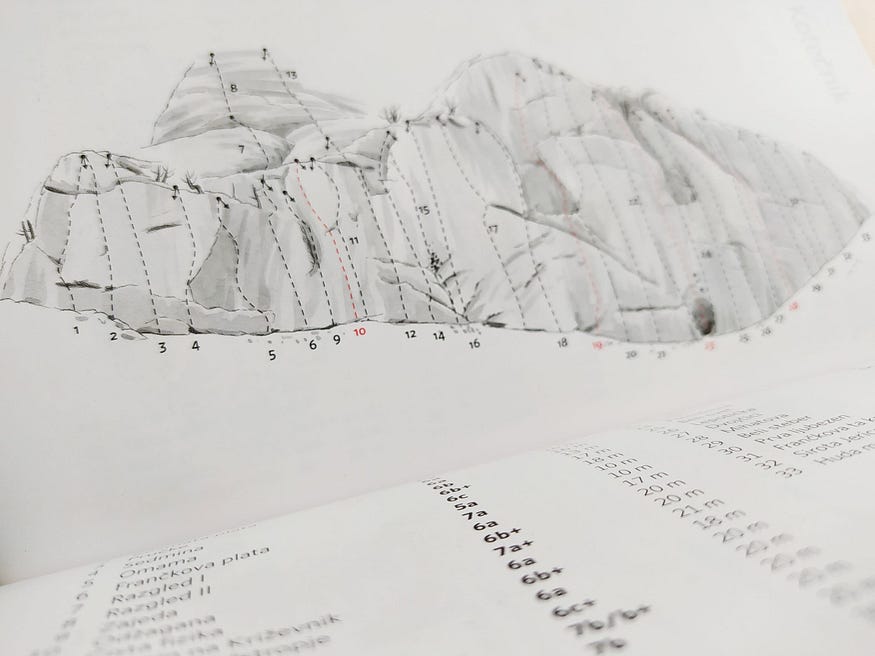
Until last summer, when I went through a major climbing crisis on a trip to Paklenica, and came out determined that I either stop climbing at all, or start training and raise my level considerably. And the first way was never an option, so I started climbing at least twice a week. Together with some colleagues, we formed a group, and we started pushing each other, and we could see the progress from session to session.
But there was one more thing. I knew that I had a fear of falling and that it was significantly affecting my climbing. So, for the first time since my climbing instructor told me that falling is a part of sports climbing, over 10 years ago, I internalised that concept. Before, I was always climbing within my comfort zone, doing moves that I was almost certain I could pull off. And if you do it that way, the progress is slow — you get better while your comfort zone gradually expands, always staying on the safe side, staying in a balanced state. But if I allowed myself to try the harder moves that I could maybe do, to take risks, jump out of my comfort zone and out of the balanced state, or literally speaking, to take a fall, I could probably pull off some climbs that would be impossible with the previous method.
So, I needed to get comfortable with falling. The fact that I started doing alpine climbing helped a lot, as I gained a new perspective on the distance between the bolts (and consequently the distance of the fall). Before, the bolts in the crags sometimes seemed far apart. But in the mountains (where there are often no bolts, but pitons and cams and other stuff), you get a whole new perspective on what far is. And coming to a crag, my new point of view would be: ‘hey, that’s not that far.’ So the whole concept of falling in the crags somehow felt less scary. It’s also objectively really safe, and I’ve finally grasped that concept. So I started training little falls, and I was slowly gaining confidence.
I would still use a mix of the approaches — first try the route on top rope (with the rope fixed through the anchor above, where there’s no real falling), and then, knowing the moves, I’d go lead climb it (which means clipping the rope into bolts and quickdraws as you climb. If you fall, the quickdraw below you stops the fall. This is the way that counts). And it was semi-successful. As one of my colleagues observed, there were cases where I would climb the route easily on top rope, but I’d be too pumped to repeat it while climbing in lead. And he suggested I should just go for it on the first try.
And I took his advice and decided to avoid top-roping as much as possible. There was one time, when a bunch of us were climbing together, and I was pretty exhausted, but someone told me that there was a really nice 6b and that I should go try it. 6b was my max at that time, so I was pretty sure I wouldn’t climb it on the first try, but I decided to give it a go and use it as a falling practice. My colleagues were telling me where the holds are and cheering me, and it was pretty hard, but I had a good feeling, no fear of falling, so I committed. And I did it. I climbed it. Flash attempt. Just like that.
Then, winter came, and we switched to drytooling (climbing with ice axes and crampons), so I couldn’t compare the grades directly. And sometime in the winter, I found a series of YouTube videos that gave me a revelation — there was this guy, Ben, who took a 6b climber and got her to climb (spoiler alert!) a 7b in 10 days. Yes, that’s right. 10 days. According to him, climbing has 3 components: strength, technique and mental. He couldn’t do much about the first two in such a short amount of time, so the videos really showed what the mental component can bring.
I was astounded. I knew that overcoming my fear of falling would allow me to improve, but I didn’t realise it could make THAT MUCH of a difference. There were also quite a few similarities between the climber in the video and me — her hardest route was also a 6b, she’d been climbing for a while, and she’d not done so much lead climbing and had a fear of falling. So if she could do it, chances were I could do it too. I didn’t have a Ben that would coach me through the process, so I knew that if I wanted it, I’d have to do it myself, but the videos provided the initial motivation as well as a ton of guidelines.
So I embarked on a journey. The first part of it was staying in shape through the winter, until the temperatures were high enough for some serious rock climbing again. There was the whole covid thing, and we were in a full lockdown, so it required some creativity, but I managed it. I also worked with my fiancé (who is also a climber) on the belaying techniques and soft catches of the falls, and I was gaining confidence in him, which was a crucial part.
So when everybody was still ski-touring, my fiancé and I opened the rock season. We took it up where we left off in autumn, and we soon began projecting harder routes. Our first 6c took both of us two visits to the crag. And then a few more came after that. There was a 6c route that I found quite hard but really interesting (and a bit scary) that took me several tries. But I felt like a winner when I climbed it — I really gave it my all (and I almost puked right after the crux, with my eyesight getting blurry and my muscles turning to jelly. But I managed to stay on the route, get myself together and finish it). So I was sitting on the ground, untying the knot, feeling great about my achievement, when my colleagues told me that the route was actually a 6c+. Go figure! Seems I overlooked that in the guide. So I’ve pushed the bar higher without even knowing it.
After that climb, I had a discussion with my colleague about what kind of routes suit my style of climbing, and he suggested a 7a route that I should try. It was in a crag that I like, and its name, Čista fizika (that translates to pure physics) spoke to my inner physicist. So I decided I’d give it a try.
On our first two visits to the crag, the route was wet. So we climbed a 6c next to it, along with some other routes. On the 3rd visit, it was dry. So we fixed a top-rope (this was way too hard to just try, with the bolts in the crux far apart, so you can’t study the moves). And we familiarised ourselves with the route. It felt really hard at first and I wasn’t sure I could do it, but I studied the holds and found all the footholds that I could use, and by the end of the session, I knew the sequence and could do all of the individual moves, but I couldn’t link them yet. So on the next visit, I was quite confident that I could send it. It felt appropriate as it was the last session before the trip to Paklenica, one year from when it all started, and I was almost a bit cocky. Only to be totally crushed the moment I came to the crux. The moves I did the last time felt impossible!
So I ran out of time and the route would have to wait for a week, and it left me with an unanswered question: did I have a really good day the first time and a normal day the second time, or a normal day the first time and a really bad day the second time? I was hoping for the second option, but I was determined to return to it anyway.
So after Paklenica, I took the first chance I got. It was after some rain, and some of the crucial holds were wet. I started with a top rope and soon found out that I must have had a bad day on my previous try, as I could do almost all of the moves again. All but two moves on that wet hold. I tried to dry it and decided to give it a go to send it anyway — in any case, it could be a practice of falling. I did all of the moves up to that wet pocket and then indeed fell off it. I then used a quickdraw to get to the next hold and finished the top part of the route. This was the first time I’d led all of the moves, and that was not a small thing, as the two bolts before and after the crux are a bit further apart than the others, so it took some courage to really commit. I also fell off the crux, giving it my best, so I was proud of myself, and I took another practice fall from a few holds higher, just to see how it feels. And both falls were great, soft, into the air, so I trained my subconsciousness that it’s ok to fall there, which meant I would be more relaxed on the next try.
So the 4th time, I was again pretty sure that I’d send it. I was a bit weary due to previous experience, and I hoped it would be dry. It was, so I was immediately in a ‘send it’ mindset. No tope-roping this time. I remembered the sequence. I warmed up, took a few breaths, visualised the moves, and went for it. I climbed the crux traverse, where I’d fallen from the wet hold before, I was able to hold the pinch, get the leg high, stand up on it, reach for that good hold that marks the end of the crux … and fell from that last move, inches from the last hold.
The fall was a long one — my longest lead fall yet, but it was soft, great for training the mind and not a fall that I’d do on purpose, so I was happy it happened even though it meant I’ve failed. I rested for a while and then gave it another try. The last try. The one where I send it. I was composed and precise, I climbed the traverse, catching that pocket felt easier than ever before, then the pinch, get the legs higher, slowly balance on the leg and reach for that redemptive hold, feeling it beneath my fingertips… and falling again.
I cried out in anger. OH THE FRUSTRATION!
I did the crux TWICE and fell TWICE on the move that posed NO PROBLEM for me before!
My belayer lowered me to the ground. I was utterly disappointed. I was pumped — I only had those two tries, I didn’t have the strength for the third good try, and I blew them.
But I wasn’t giving up just yet. And neither did my colleagues. They cheered me up and told me that I have time for a rest and another try before it became dark. And I did take a rest. And gave it one more go.
There was only silence and breathing and a song playing in my head. I’ve pushed everything else out. Up the easier first part. I felt that my muscles were still tired from the two tries, so I had to be super-efficient. Stepping on that micro ledge. Using a knee bar to rest my hands before the crux part. Locking my core when traversing to the pocket. Precise footwork. Right hand to the side hold, left to the pinch. Right leg up to a marked foothold. Left leg up. Lock the legs to pull myself to the wall and adjust the grip of the left fingers. Stand up. Balance. Reach. Reach.
YES! I HAD THE HOLD!
I tightened my grip around it and I was still on the wall! Now I just need to keep it together for the easier top part. And I know from experience that it’s super easy to mess it up after the crux, so I take a few deep breaths and clear my thoughts and finish the route.
I did it. I climbed my first 7a.
Well, actually, it’s 7a+, but that’s not important. What is important is that I’ve climbed something that I long thought was almost impossible, a once-in-a-lifetime thing that would require sacrifice and training hard. And I did it with not much additional training to what my normal routine was. Just with a different, more focused approach, and without the fear of falling.
And once I figured out the sequence, it didn’t feel so hard. So if I trained harder, where are the limits?
I felt I had reserves left and I was ready to test the limits again soon on another hard route and maybe push them further, but my life had other plans. The next day, my fiancé came from work with a headache that turned to a cold (the mix of air conditioning and the fact that we just came back from the weekend on the glacier above 4000 m and were still not fully rested combined with the middle-of-the-night walk from the crag prepared the field), and I got sick a week after him (though my theory that we never infect each other held, I didn’t count on his cold stressing my immune system enough that I would be susceptible to other things and I caught a viral infection (not covid) at work). So we were out for a month. And in a month, a lot of finger strength can be lost if you don’t train (but that’s another story), so we had to ease back into climbing. So as of yet, Čista fizika remains my only 7a. But I am determined that there’ll be others.
Cuz now, I’ve opened the box, and I know what’s possible when one loses the fear of falling.
And if it had such an effect in climbing, what happens when you apply it to life?
To overcoming the fear of falling!
Nika
_________________
Here’s the link to the YouTube channel I mentioned: https://www.youtube.com/c/HardIsEasy
I highly recommend the videos about overcoming the fear of falling and the one about the physics of falling.