
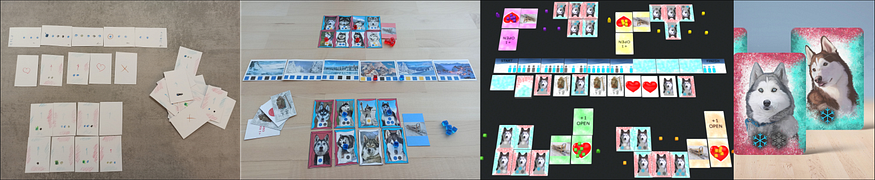
Taking an idea and turning it into a prototype. And then a prototype number 2. And a prototype number 3.
Now this is a topic where I feel right at home! I’ve been involved in creating quite a few prototypes — from the experimental work for my Master’s thesis, to working in the development department. And the idea part has never been a problem, they seem to come very naturally to me.
This was also the case with the idea for this board game. We’ve watched a movie called Togo a few weeks prior, in which there is a pandemic outbreak in a remote town in Alaska, and the only way to get the cure is with dog sleds. They organise a relay, and the movie follows one of the mushers (= dog drivers) who covers the longest distance. I liked the movie and the cast and the whole flow. It stated to be based on a true story, which I think is often used as a means to get some (false) credibility and draw in more viewers, while the true events are featured very loosely. So I usually do some research if a line like that appears in the credits.
I found that much of the story was actually in line with the historic events of the 1925 serum run to Nome. I was impressed by what the mushers achieved and a bit surprised that the events were well known to the public and featured in popular media. I then did some more googling about dog sledding in modern days, about the equipment used, and the races. A few hours on the web satisfied my curiosity, and I was ready to close the chapter.
But I think the theme stayed with me somewhere at the back of my mind, because a few weeks later, I got an idea, out of the blue, without thinking about it, for a board game with a dog sledding theme and coloured edges of the husky cards, that the player would have to match when assembling the sled. So it was a combination of theme and mechanics. It was similar to my first idea for a board game, the one that is complex and I’m saving for another time — there, I knew it would be about building human-powered airplanes, and the mechanic would be worker placement and some special system for the weather, and some other details.
I liked the idea — both the theme and the pattern building, and I shared it with my fiancé over lunch. And he said: “Sounds simple enough — let’s try it.” We first discussed it a bit and realised that having three different colours for edges would probably be too much, if the sled was 2×4 cards large, so we decided to go with just two. After that, we came to the point that we couldn’t imagine it further, and my fiancé brought some paper and scissors, and I found some crayons, and we started drawing arrows and bullets. We had a prototype done in an hour.
Proof of concept
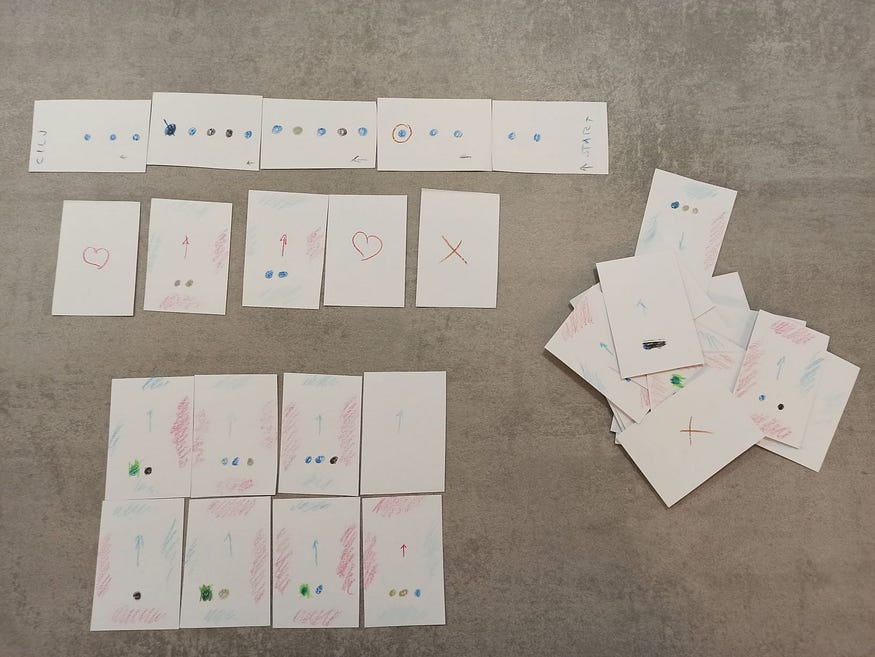
This was the ‘proof of concept’ prototype — the one that has the bare minimum that’s needed to determine if something is working or not, but it’s not pretty, and it still needs a lot of work before it becomes a finished product. I became intimately familiar with the ‘proof of concept’ concept during the experimental work for my Master’s thesis, when we were trying to test a new concept for a velocity sensor in microfluidic channels. We encountered problem after problem, but we ended up with an experiment that showed that the theoretical principle does manifest itself in practice. Was it ready to be put into use? Not even remotely. But did we demonstrate that the concept is working? Absolutely.
So this was that kind of a prototype. We went straight into testing it, making modifications as we went, drawing additional bullets and crossing them. It was rough and unbalanced, not thought through, but we liked it. It was simple and fun, and we liked the pattern building and the combinatorics element that came into play in the race phase. We thought it had potential.
But we were personally involved in it, so we decided we needed to show it to some other people (who are close to us, and who like board games) to get a second opinion. We were in the middle of a lockdown, but we were lucky enough that we had a few people who fit (at least the first part) of the description in our social bubble. And we kindly asked them if they would try the game with us. Some were up to it right away and others needed some persuading, but they couldn’t really refuse me, as there’s no straightforward way to test a six-player game with four players, and they are biologically programmed to love me. (Hi mom and dad! You are probably one of the best kinds of parents a person could wish for.)
They liked it too. And I know they are biased to like it, but I also know (or at least I think) that they would tell me if it was total rubbish. They weren’t very impressed with the arrows and bullets, though, and it required some imagination to see the huskies and snowy wilderness in them. So we knew that we needed to do something about its looks before we showed it to more people. But first, we thoroughly play-tested the game, both between the two of us and with the two members of the household that actually like board games, namely, my sister and her boyfriend.
We made a lot of adjustments. The two major things that we were focusing on were determining how many movement points the husky cards would get, and what kind. Each husky card has movement points that you use in a race. Every round (called a day), you can use all of the huskies’ movement points, husky by husky, to move over the terrain fields and advance in the race. We knew we wanted to have 3 different terrain types, and we played around with their combinations and frequency on the landscape cards (=the race track). We also knew that we wanted to have husky cards with more than one movement point, so the order in which you use the huskies would matter. We took the time to really find a good ratio of husky cards with one, two and three movement points and tweaked it so that the frequency of terrain types on the husky cards would make sense compared to what was on the race track. We also played around with the length of the track.
Adding the theme to the prototype
Once we were happy that the game was playable, we focused on incorporating a theme. We searched for husky and winter landscape photos on the internet and used Inkscape (a great program for vector drawing) and my dad’s printer to create the second prototype. So, we were ready to show the game to the world. Or at least a circle of friends. Due to covid, our first playtests were over a video call. We were creative and prepared a setup with two cameras, one on a laptop, sitting on the table, and one on the phone, hanging from the ceiling, but in practice, we ended up using only the laptop 90 % of the time.
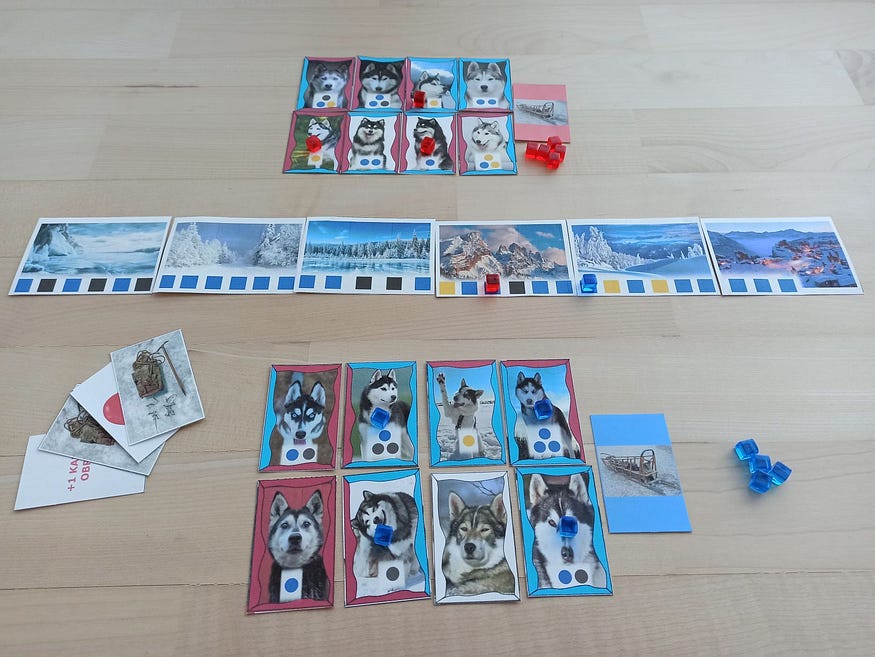
It was a bit unusual, as we had to move everything for the people on the other side of the connection, and we also learned that the blue and black that we chose for the movement points were not distinguishable over the camera. But we could see that our friends were intrigued by the game and that they were excited to play it and think about the combinations that would be optimal for using movement points in the race. We would rarely play more than two games in a row, though, as the quirky setup over the internet was not really user-friendly and left to be desired.
We then did some in-person playtests outside, on a ping-pong table in our backyard, respecting all of the distancing rules. They were different from the online setup — better in the sense that each player could move their own components, could clearly distinguish between the colours, and the interactions were a bit more natural — but it was still winter, so it was cold, and the sessions were therefore short.
During this testing, it was clear that the special cards (equipment cards and care cards) that we had in the game were not yet well balanced. We needed to find a way to adjust their number, or add another way which they could be used. We also learned something very interesting. We have friends who like games that require thinking and strategy, and friends who love push-your-luck games, and all of them liked Hike! It seemed that we found a balance that had enough luck element mixed in with some pattern building and combinatorics, which catered to the players from both ends of the spectrum, and we were pleased with the findings.
Online prototype
We had several ideas regarding the special cards that we wanted to test, but at that point, we were involved in the development process so much that we felt like we needed fresh sets of eyes. And as the video call and outdoor play sessions were less than optimal, we decided to create an online version of the game. None of the team members use any of the online gaming platforms, so we first needed to do some research and we asked our friends and on the Board Game Geek forums about what they use and like.
We learned that there are two ways to go — first are the platforms like Tabletopia and Tabletop Simulator, where you upload components and the software simulates the physics, but you are responsible for knowing the rules, and on the other hand, you have platforms like Board Game Arena, where the rules are implemented in the software. The first way is easier from the standpoint of making an online version, as it requires no programming; you just upload the components. In the end, we decided on Tabletopia.
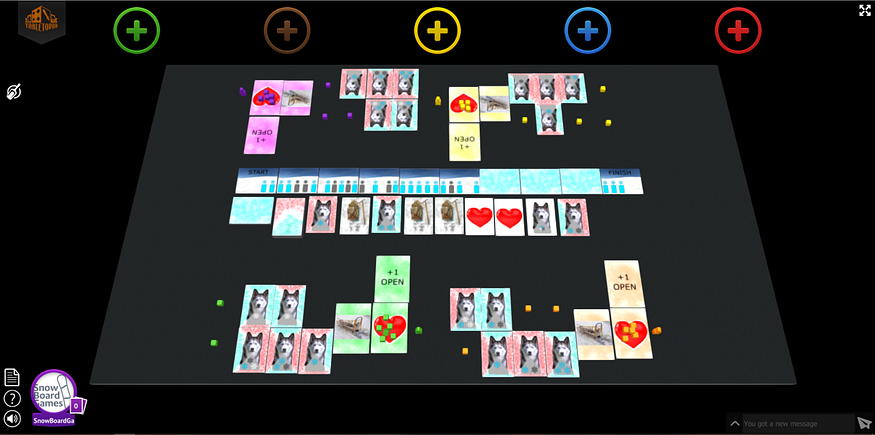
Hike! prototype number 3 — the online one.
So we started preparing the components. We modified the images and symbols on the cards a bit from the previous prototype — firstly, to include only materials that were ours or licensed appropriately for use in an online game, and secondly, to make the components colour blind friendly. I’ve been thinking about that aspect from the beginning, when I got the idea for pattern mechanics, and we did some research on how to implement it in a way that would work. We again did some research and asked around. We found a Facebook group about colour vision deficiency awareness, and we got some really valuable advice from their members. The most important of them was to add colour-specific patterns.
Once the game was uploaded, and we had our third, ‘online’ prototype, we hosted a number of game nights. They were infinitely more fun than the previous method. We would be on a conference call, usually with the cameras on, and we would play at the virtual table, so the interactions were surprisingly similar to those at a conventional game night. (I still can’t wait for things to get back to normal, though, but this was a decent substitute.) We were enchanted by the amazing feedback we got, and we tweaked the gameplay from playtest to playtest and slowly found a sweet spot.
Adding the actual art
Next, we took on a humongous task of writing a rulebook and we’ve started with some blind testing. At the same time, we were also getting art pieces from our illustrator, so we started thinking about the next prototype — the one with actual art. We are currently combining the art to make the cards, and I think the next prototype will be one that will still be printed with a home printer and played with card sleeves. So that we can see how it all looks on the table.
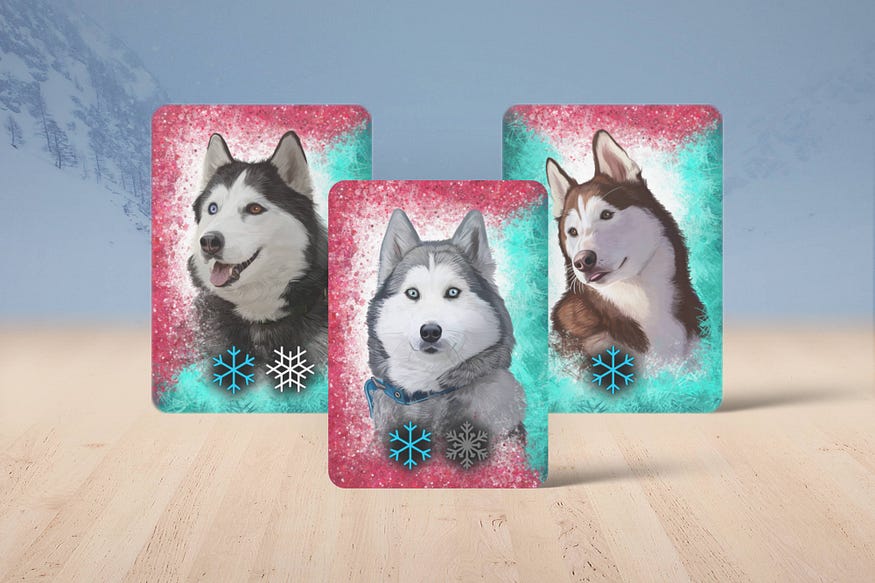
And then, I think we’re talking about a real prototype, the one made by a professional company. And then a small series. And then a large series, if the Kickstarter campaign is successful. And before it, the prototype to make sure the print files are prepared correctly and the colours and materials turn out the way we imagined. The last in the long line of prototypes. We’ve made a few of them, I think they were a great investment, as every one of them allowed us to do the next step in testing and developing the game.
To ideas, prototypes and tests! May your ideas be great, your tests fruitful, and your prototype cycles short!
Nika